Monday, November 21, 2011

Test Essay - 3

Looking back on human history, the most evident and obvious achievements that have been recorded or that still exist today are the architectural feats. Whether we look at the Chinese and their Great Wall, the Egyptians and the Giza pyramids, or even to more recent European history to locations such as the Cathedral of Notre Dame, the architectural and technological displays that each dynasty leaves behind is a clear and descriptive representation of the civilization as a whole. However, taking into the account the time span in which these were made, as well as the resources and technology available to each civilization, it becomes obvious that many of these communities had to use slave labour in order to achieve their goal. Whether this is an immoral act or if it is just the natural course of a civilization, it is clear that in ancient history and in our modern day to a certain extent, slaves were required for the creation of great achievements.

The first and possibly most well known example is the Great Wall of China. Started during the Qin dynasty between 221BC and 206BC, the great wall was often dubbed the longest grave yard in the world. In the few years the Qin had worked on the wall, over 3000 slaves that ranged from criminals to peasants died on the job, lacking nutrition and proper wages. Not only would the Great Wall not have been possible without the use of slaves, considering its massive size, but the Chinese as a race may have been influenced drastically if not for the protection against the Mongol invasions that the Great Wall provided. Another prime example is the pyramids of Giza. By hiring and training thousands of skilled workmen to work full time for decades without rest would have completely drained Egypt of their resources and by pulling in tens of thousands of slaves the project was possible. The argument that now comes in is that: was the means of construction justified? Iconic civilizations such as Mayans, who had poorly paid workers to work away on pyramids, would come away with a religious site that benefitted and brought together the community at the time as well as leaving a marvel for the rest of the world and for civilizations that would follow to admire. In my opinion, although the slaves would have been treated poorly, the construction of these spectacles is a necessary part for a civilization to leave its mark on human history.

In today’s age in first world countries however, slaves are no longer needed. With the technology that has been developed over the last decades, the man power that machines such as cranes or bulldozers provide simply removes the need for much of the manual labour required in the construction of these types of architecture. Even with workers, the implementation of technology allows for proper payment and treatment. Ironically though, with the convenience of modern day technology, the aura or “wowness” factor behind the spectacles are much harder to obtain. When looking at the Stonehenge for instance, a religious monument built between 3000BC and 2000BC, the fact that a whole community collaborated for perhaps as long as centuries to create a tribute to their religion is much more fascinating than anything that has been built in recent history by the means of machinery.

The final point to make is the incentive of the rulers who forced the slaves into work as well and if their decision was justified or not. For example, the construction of the Parthenon that was built during the golden ages of Ancient Greece was heavily reliant on the usage of slaves. Pericles wanted to set the standard for architecture in the western world, as well as showcase the advancements of the Greek civilization through the building of the Parthenon and for this to happen he needed an efficient and affordable work force. Not only was he trying to create a monument to show Greek power, but the building itself was a temple dedicated to the Goddess Athena. This would have, without a doubt, been a popular decision with the higher members of not only Athens but of many city states in Greece. I think the justification of the usage of slaves is legitimate here, as its purpose was to provide a culmination of all Greek culture as well as serve a purpose to the entire community of Athens, and while many slaves died in the making, it simply could not have been done in any other way.

Slave labour now would be heavily looked down upon, but the fact is that hundreds or even thousands of years ago, these architectural feats could have been accomplished in any other way, and with much more imbalance in the social structure and discrimination towards lower classes, the usage of slaves was much more acceptable. The buildings that still stand today definitely show how much dominance that civilization would have had as well as their dedication to either the religion or icon that the community worshipped. In our current world, building a pyramid out of stone would be a difficult but definitely achievable project, but looking back thousands of years to tens of thousands of slaves who dedicated their lives to creating a monument to their king is simply unmatched in today’s culture.

Friday, November 18, 2011

Temporary: Essay Questions - Test 3

*Under Construction*


To what extent could another civilizations (instead of Europe) have possibly conquered the world between 1200 and 1600 AD? What accounts for their failure to do so?

What factors have contributed to the rise of civilizations and their eventual collapse?

"Slavery is necessary for great achievements." - Amy

Thursday, November 17, 2011

Siddhartha questions.

What kind of child and son is Siddhartha?

Siddhartha was essentially the perfect son. Born the child of a Brahmin, Siddhartha always pleased those around him, especially his parents with his vast knowledge and thirst for more. Even physically, Siddhartha, with his thin physique and tan skin, would make even his closest friends like Govinda jealous. Even at his young age, Siddhartha had already mastered the Om as well as many facets of the Brahmin lifestyle. However Siddhartha did not see himself in the same light. He became very pessimistic towards his future, and was suspicious of the joy that was felt around him. He did not appreciate the beauty and joy around him which ultimately lead him away from home to find true bliss.

Who are the Child People, and what are their values, concerns, weaknesses, and secret?

The child people, for the most part, are the general citizens such as the traders and the gamblers, or perhaps anyone who is not a Samana or Brahmin. Siddhartha sees himself as an adult, or someone who knows himself very well and understands as well as follows the key philosophies of life which hold him back from leading a wholesome life. The Child People on the other hand, are much more consumerist, living in the material world around them and only concerning themselves with tangible items such as money, property and goods. They indulged in love and were subject to emotional feelings where as Siddhartha felt he had a much better understanding and was essentially higher than the Child People.

What does Siddhartha teach Govinda?

In the final scene of the book, Siddhartha explains the knowledge he has gained over the years and all his travels. While the Buddha attempts to teach through what the Buddha has learnt, Siddhartha realizes that wisdom cannot be taught, and that words hold little meaning. He told Govinda that one must learn from themselves, and choose their own path with their own morals, and believed that the best teacher is the environment around you and yourself. Finally, Siddhartha shows that it is okay to love and be loved with those around you and feel emotion, and to believe that the world is perfect and to see grace in all sins. Ordered by Siddhartha, Govinda kisses Siddhartha on the forehead and instantly is overwhelmed with all the happiness he has ever felt.

Wednesday, October 26, 2011

Test Essay - 2

Plato’s philosophy and Athenian society

By Thomas

Plato’s allegory of the cave is one of the most famous and relevant philosophical ideas in human history. Hypothesizing that we are, in fact, living in a world full of lies and shadows, and that one must exit this false world or “the cave”, and see the true light before returning to retrieve the other members of society and enlighten them as well. Perhaps the reason why this philosophy is so well known and acclaimed is simply because it is so relevant to almost every civilization, and every society in one way or another. For example in today’s world, we are blinded by bias media, corrupt governments, and propaganda which drain us of any personal opinion, leaving us only with the false information that we take in that can be easily manipulated. This analogy, however, can relate back to the Athenian civilization as well, regarding possibly one of the Greeks most fatal mistakes and the conflict that the society had with Socrates. The ethical decision by Greece to execute Socrates may not have been entirely correct; however it is apparent how Socrates became the victim in what was the Athenian cave of shadows.

The trial of Socrates took place in 399BC, in Athens. After the long and gruesome wars with Persia, and the occupation of Persia in the Athens, Athens finally re-established their democratic ideals. Socrates however, continued to theorize of anti democratic governments, including the “clean slate” theory and share his wisdom openly in Athens, causing fear of revolution from the Athenian government. This would lead to the arrest, trial, and eventual death for Socrates. Ironically this can perhaps correlate directly to his pupil, Plato, and his philosophy of the cave, and although it can be argued whether the death of Socrates was a democratic decision or not, it is hard to ignore the fact that the Athenian society had directly eliminated, in Plato’s terms, a potential philosopher king who could have very well brought Athens to the absolute truth.

Plato believed that we are all born in a world where we see only a shadow of the reality, and that there would be someone who rise above and experience the world for what it truly was, but upon his return to enlighten the rest of the community, he would look foolish, and only when the society would understand what the philosopher knew, would the civilization emerge from the cave and know the absolute truth. In Athens, Socrates was a well known and well regarded philosopher, who, we can understand, was attempting to guide Athens out of the cave, making him the philosopher king. However the public did not agree. With the recent tyrannical period of Critias, and Socrates’ close relationship with him, the Athenian democracy shut down the idea of Socrates’ clean slate theory, and his abolition of democracy for one true philosopher king to rule over the entire state. As you can see the lines can be very accurately drawn between the allegory and the reality. The ethical argument of killing Socrates aside, I believe there is a major hole in the theory of the cave, and that is, how can one truly know that they have witnessed or have knowledge of the true world, if in fact we live in a cave of shadows? Athens may have understood that their current state was the absolute truth, and in fact they had already emerged from this cave, which makes the death of Socrates completely correct in their case, and his philosophy false. Then again, if Socrates’ philosophy was in fact the absolute truth, would the Athenians prefer it over their current state? While I believe the death of Socrates could have been one of Ancient Greece’s few mistakes, and that Plato’s philosophy can easily compare with the trial, it is very hard, given Greece’s state at the time, to justify one side more than the other, as neither believed they were in the wrong.

While Plato’s philosophy can be interpreted in many ways, its relation to the trial of Socrates can be interpreted and investigated in many ways. Socrates saw himself as a philosopher who’s ideas were correct, but at the same time contradicted many of Athens ideals such as democracy. Just as in the cave philosophy, the society ridiculed Socrates and saw him as a threat of influence and executed him. According to Plato this would have been a failure of the civilization, who were not ready understand the absolute truth, but in many ways, Socrates’ ideas may have destroyed what was a functional Greek society. While the Greeks may not have been in the right by killing Socrates, the conflict over who was the “philosopher king” is impossible to settle.

Thursday, October 13, 2011


Human Condition - Analysis

By Thomas

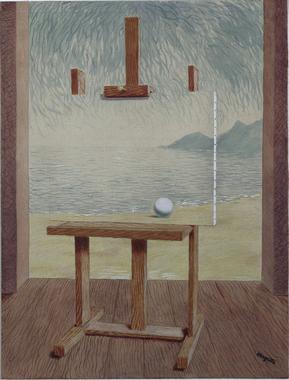
Human Condition or La Condition Humaine is a series of surrealist paintings by 20th century Belgian artist Rene Magritte. The works were painted throughout the mid 1930s and the early 1940s, and were painted with oil on a canvas sized 100cm by 81cm. Initially an impressionist, when Magritte transferred to surrealist art, his style also carried over. This is clearly exhibited in Human Condition, where Magritte paints with impressionistic qualities.

The 1945 Human Condition like most others in the collection were set in a house overlooking nature. In this case we are set in what looks to be a beach house that opens to a beach with a blue sky and mountains in the distance. The brush strokes are fluid yet determined giving a mixture of impressionistic and realistic qualities. The piece is focused on an easel with a canvas that hides a portion of the landscape from the viewer, but at the same time reimagining it on the canvas in the same style as the rest of the scene, making it seem perfectly natural if not for the outlines of the canvas and the easel.

The idea that Magritte was implying, in my opinion, is that we cannot always believe what we see and the idea or object that is most important is the one that is mostly likely to be hidden. It is human nature to try to uncover what is hidden from us, and this painting is a perfect example for when people view it, most will only wonder what is behind the easel rather than contemplate on what is shown to us. Another point is how the truth can be hidden from us, especially in the world we live in today with bias media and corrupt governments. The simplicity of the scene with its peaceful nature and general calmness may trick us when the reality may be the complete opposite. In Human Condition, Magritte combines great artistic skill while presenting a deeply philosophical, underlying message, creating surrealist art at its finest.